
The 5th International Conference on Electrical Engineering and Mechatronics Technology (ICEEMT 2025), hosted by Southern University of Science and Technology and organized by the School of Automation and Intelligent Manufacturing of Southern University of Science and Technology, was successfully held and concluded in Shenzhen from October 17th to 19th, 2025. This conference brought together experts and scholars from renowned universities and research institutions around the world to jointly discuss the latest technological advancements and research achievements in the fields of electrical engineering and mechatronics, promoting international academic exchanges and cooperation.

The opening ceremony of the main venue in the morning of the conference was presided over by Professor Liu Derong, Chair Professor of Southern University of Science and Technology [Academician of the European Academy of Sciences, IEEE/INNS/IAPR Fellow].


Professor Marios Polycarpou from the University of Cyprus, Director of the KIOS Center and IEEE/IFAC Fellow, delved deeply into the resilience of cyber-physical systems in complex networked environments and introduced intelligent monitoring technologies based on artificial intelligence and machine learning. It provides innovative ideas for enhancing the stability and fault resistance of key social infrastructure.

(Enhancing Resilience of Cyber-Physical Systems)
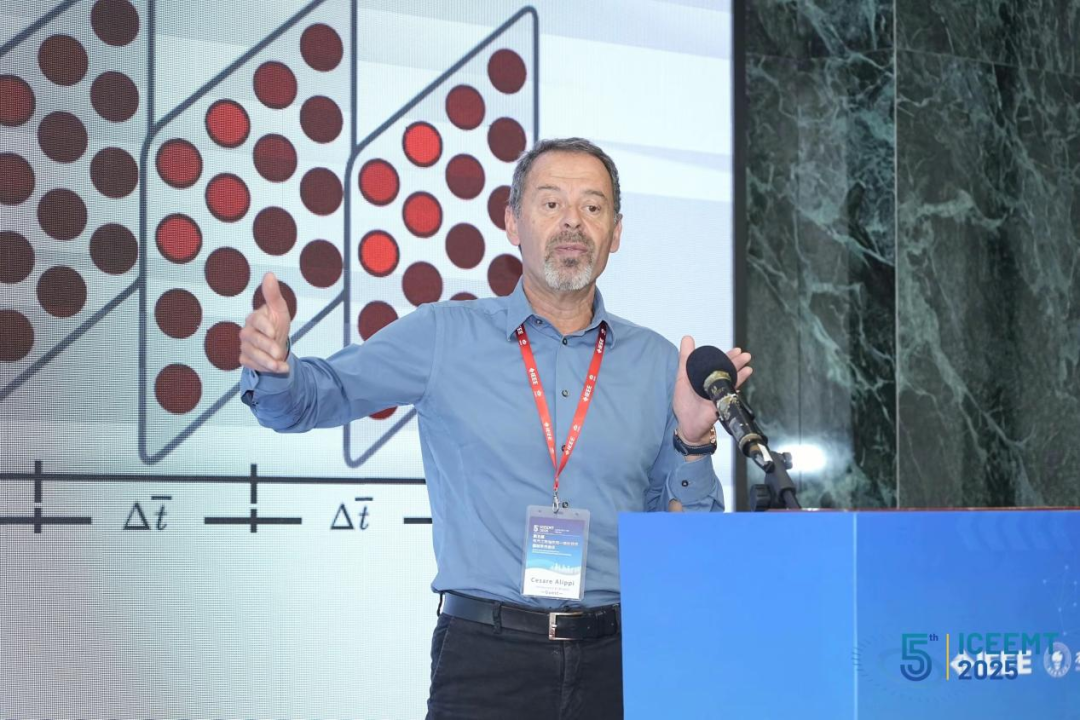
Professor Cesare Alippi from Politecnico di Milan, Italy [IEEE/INNS/ELLIS Fellow], shared the latest developments of graph neural networks in processing irregular spatio-temporal data, especially the breakthroughs in data interpolation and future prediction, opening up a new path for spatio-temporal data analysis.


The oral presentation session in the second half of the conference showcased outstanding research achievements from multiple universities and research institutions. The topics covered included the lightning current characteristics of 220kV transmission lines, the influence of multi-factor coupling, a comparison of motion capture control technologies, the thermal aging assessment of generator insulation, and the path planning of mobile robots. It also included the application of deep reinforcement learning in electric vehicle charging, fault detection algorithms for electromechanical systems, the control of permanent magnet synchronous motors in rail transit, the electrothermal coupling analysis of DC capacitors, innovative robot arm structure design, and the optimization of grid energy storage configuration and economic operation strategies for microgrids. Each presentation was highly engaging, demonstrating the cutting-edge progress and application potential in the fields of electrical engineering and mechatronics technology.